
Legal Research Services in Chennai
Legal research is the foundation of sound legal advice. Before drafting an agreement, giving a legal opinion, responding to a dispute, or making an important business decision, the relevant law needs to be understood in its proper context. A legal provision cannot always be interpreted by reading one section of an Act in isolation. Its meaning may depend on rules, notifications, judicial decisions, previous amendments, and the facts of the matter.
At Legal Prime, our legal research services in Chennai are designed to help businesses, companies, professionals, lawyers, and individuals understand the legal position surrounding a specific issue before taking action. Our work focuses on finding relevant legal provisions, studying applicable judgments, analysing the facts, and presenting the findings in a practical form that can support a legal or commercial decision.

What Is Legal Research?
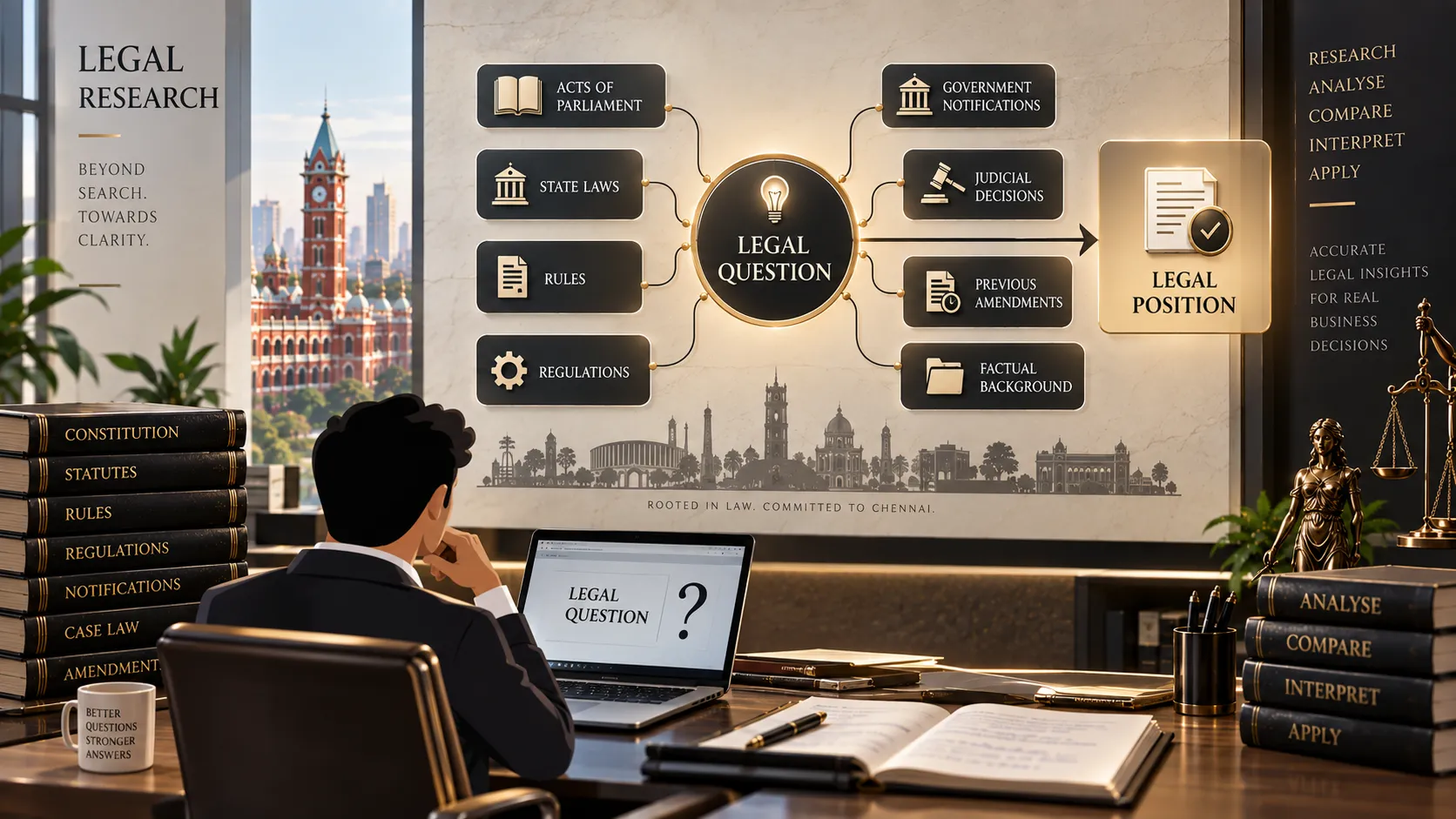
Legal research is the systematic process of identifying, studying, comparing, and interpreting laws and legal authorities relevant to a particular issue.
A legal research exercise may involve reviewing Acts of Parliament, state laws, rules, regulations, government notifications, circulars, official orders, judicial decisions, and other authoritative legal materials. Depending on the matter, research may also require examining the factual background and understanding how courts have previously approached similar circumstances.
For example, a company may want to terminate a commercial agreement because the other party has failed to perform its obligations. The answer cannot always be found simply by looking at the termination clause. Legal research may need to consider the contract, applicable statutory provisions, previous judgments, notice requirements, limitation issues, and the remedies available to the affected party.
Legal Research Is More Than Finding a Section Number
This is why legal research is not simply searching for a section number on the internet. It requires identifying the right legal question, finding reliable authorities, understanding their relevance, and applying them to the actual situation.
Why Legal Research Matters Before Taking Legal Action
Businesses often make legal decisions under time pressure. A notice may arrive unexpectedly. A contract may need to be signed quickly. A dispute may develop between a company and its vendor. A property transaction may involve an unclear title issue. An employee matter may raise questions about applicable employment laws.
Taking action without proper legal research can create additional risk.
A carefully researched legal position can help a business understand what it can do, what it should avoid, and what legal consequences may follow from each available option.
Legal research can help with:
The purpose is not simply to collect legal information. The objective is to turn relevant legal information into a clear and useful legal understanding.
Our Legal Research Services in Chennai
Legal Prime provides legal research support for a range of corporate, commercial, property, documentation, and dispute related matters.
Statutory Legal Research
We examine the laws and statutory provisions relevant to the issue under consideration. This may include central legislation, state legislation, rules, regulations, notifications, and amendments.
The research is focused on identifying the provisions that actually apply to the matter rather than providing a general list of laws.
Case Law Research
Judicial decisions can significantly influence the interpretation and application of a legal provision.
Our legal research process may involve identifying relevant decisions of the Supreme Court of India, High Courts, tribunals, and other appropriate judicial authorities depending on the issue.
The objective is to understand how courts have interpreted similar provisions and factual situations.
Corporate and Business Legal Research
Companies regularly encounter legal questions relating to contracts, employment, compliance, intellectual property, business operations, investments, and commercial relationships.
Legal research can help companies evaluate questions such as whether a contractual provision is enforceable, what remedies may be available after a breach, what approvals may be required for a particular transaction, or how a particular legal obligation applies to the business.
Contract Related Legal Research
Before drafting or reviewing a commercial agreement, it can be useful to research the legal framework surrounding the transaction.
For example, research may be required for agreements involving vendors, clients, consultants, employees, technology providers, distributors, landlords, or business partners.
The research may focus on enforceability, contractual obligations, indemnity provisions, limitation of liability, termination rights, dispute resolution, confidentiality, intellectual property ownership, and applicable statutory requirements.
Property Law Research
Property transactions can involve several layers of legal documentation and historical records.
Legal research may be required for questions relating to ownership, transfer, inheritance, possession, title defects, registration, land use, development rights, government restrictions, or previous judicial decisions concerning the property.
For companies acquiring commercial or industrial property, legal research can form part of a broader property due diligence process.
Employment and Labour Law Research
Businesses may require legal research before taking action relating to employees or workplace policies.
Research may cover applicable employment legislation, disciplinary procedures, termination issues, employee rights, workplace obligations, statutory requirements, and judicial interpretations.
The applicable legal position can depend on the nature of the establishment, workforce, employment arrangement, and facts of the particular matter.
Intellectual Property Legal Research
Businesses depend heavily on trademarks, copyrights, patents, designs, software, content, and other intellectual property assets.
Legal research may be required when a company wants to understand ownership, infringement risks, licensing issues, protection strategies, or available remedies.
For example, if a company believes another business is using a confusingly similar brand name, legal research can help identify the relevant legal provisions and judicial principles before deciding whether to issue a notice or pursue further action.
Regulatory and Compliance Research
Companies operating in regulated sectors may need research before introducing a new product, service, policy, business model, or commercial arrangement.
Legal research can help identify applicable regulations, statutory obligations, licensing requirements, reporting duties, and restrictions.
This is particularly relevant when businesses operate across different sectors or deal with customers, vendors, investors, or partners outside India.
How Our Legal Research Process Works
A structured legal research process helps ensure that the final analysis is relevant to the actual question.
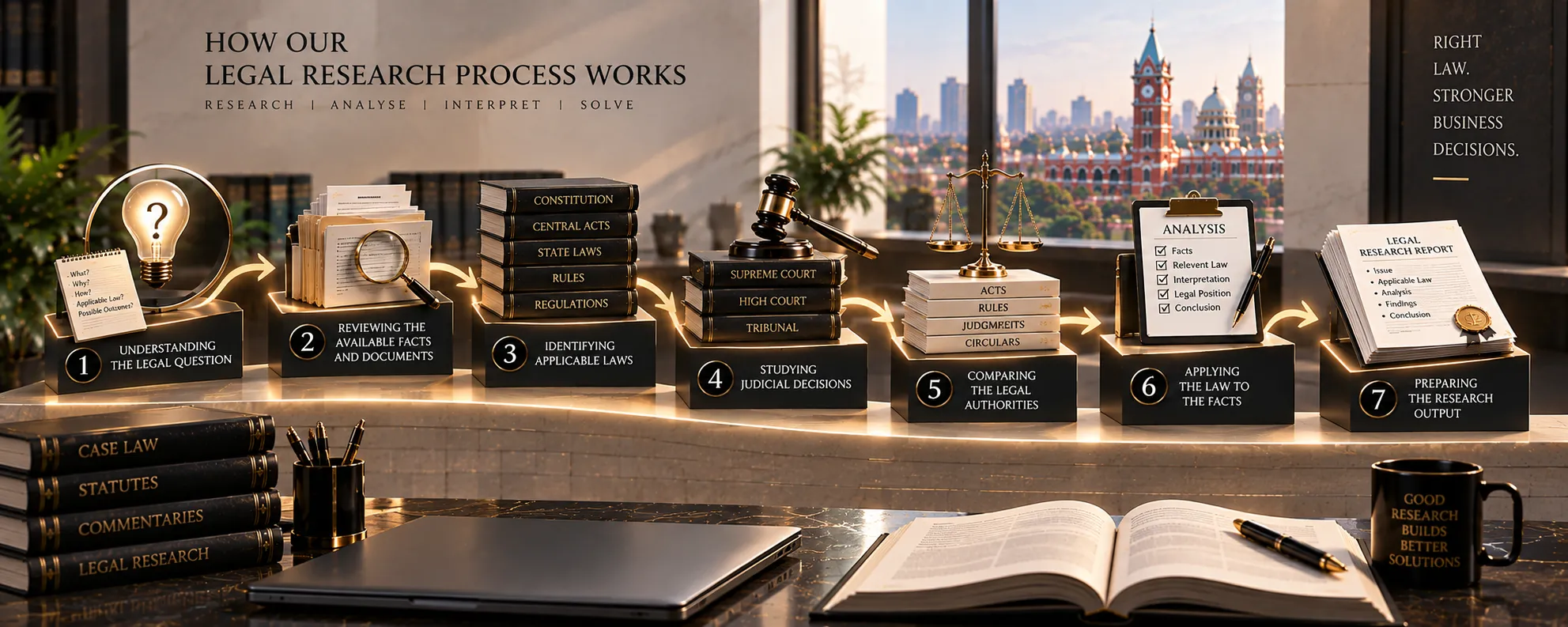
Understanding the Legal Question
The first stage is understanding what the client actually needs to know. A broad question such as “Is this agreement legal?” may need to be converted into more specific questions.
For example:
- Can this agreement be terminated?
- Is this clause enforceable?
- What happens if the other party does not perform?
- What legal remedy is available?
- Which law applies to this transaction?
- What are the risks if the company proceeds?
Defining the legal question correctly is one of the most important parts of effective legal research.
Reviewing the Available Facts and Documents
Legal research should not be separated from the facts.
We review relevant agreements, notices, correspondence, documents, transaction details, previous legal opinions, and other available information depending on the matter.
This helps ensure that the research is directed towards the actual circumstances rather than a hypothetical situation.
Identifying Applicable Laws
The next stage involves identifying the relevant statutory provisions, rules, regulations, notifications, and other authoritative materials.
Where amendments or changes are relevant, the applicable legal position needs to be considered carefully.
Studying Judicial Decisions
Relevant judgments are then examined to understand how courts have interpreted the applicable law.
The focus is not simply on finding a judgment containing similar words. The facts, legal issue, reasoning, and final decision need to be considered before determining whether the judgment is relevant to the matter.
Comparing the Legal Authorities
In some matters, different judgments may address similar issues in different factual circumstances.
A proper legal research exercise therefore requires comparison and analysis.
The importance of a judgment may depend on the court that delivered it, the factual circumstances, whether the decision has been followed or distinguished, and whether later decisions have changed the legal position.
Applying the Law to the Facts
This is where legal research becomes useful to the client.
The research findings are considered against the actual facts and documents to identify the practical legal position.
Preparing the Research Output
Depending on the requirement, the final work may take the form of a legal research note, case law summary, statutory analysis, legal opinion support document, issue based research report, or detailed research memorandum.
The format depends on how the research will be used.
What Does a Legal Research Report Usually Include?
A legal research report may contain:
Where appropriate, the research can also identify areas where the available legal position is uncertain or where further professional advice may be necessary.
This distinction is important because legal research should not create a false impression of certainty where the law is unsettled or the facts are incomplete.
Legal Research for Businesses and Corporate Clients
For companies, legal research is often connected directly with commercial decision making.
A business may approach legal research services before signing a major agreement, entering a new market, acquiring property, launching a new product, restructuring a business relationship, responding to a legal notice, or dealing with a dispute.
Legal Notice
For example, consider a company that receives a notice alleging breach of contract.
Legal Research
Before responding, the legal team may research the relevant contractual provisions, applicable law, limitation issues, previous judicial decisions, and available remedies.
Business Decision
The outcome may help determine whether the company should contest the allegation, negotiate a settlement, issue a detailed response, or take another legal step.
This type of research supports preventive legal decision making rather than waiting until a dispute reaches court.
Illustrative Business Research Scenario
Consider a technology company that wants to use a third party software platform under a commercial agreement.
The company may need to understand who owns the underlying intellectual property, whether the licence permits the intended commercial use, what happens after termination, whether customer data can be transferred, and what liabilities may arise from the agreement.
What the Research Examines
A proper legal research exercise would examine the contract, relevant intellectual property and technology laws, applicable contractual principles, and judicial decisions where relevant.
The purpose would be to identify the legal issues before the company commits to the arrangement.
This is an illustrative example of how legal research can support business decisions. It is not presented as a specific Legal Prime client case unless separately identified as such.
Legal Research for Lawyers and Legal Professionals
Legal research is also useful as professional support for lawyers and legal teams handling complex matters.
A research assignment may involve locating relevant judgments, tracing the development of a legal principle, comparing decisions, checking statutory amendments, or preparing a focused research note.
For matters involving multiple legal issues, structured research can save time while allowing the advocate handling the matter to focus on strategy, drafting, negotiation, or representation.
Legal Research and Legal Drafting
Legal research and legal drafting are closely connected.
A contract drafted without understanding the applicable law may contain provisions that are unclear, commercially unsuitable, or difficult to enforce.
Research can help the drafter understand the legal framework before preparing the document.
This is particularly important for complex commercial agreements, employment documentation, intellectual property agreements, property transactions, settlement arrangements, notices, and other legal documents.
At Legal Prime, legal research can therefore support our broader legal drafting services where the nature of the assignment requires detailed legal analysis.
Legal Research
Understand the applicable laws, authorities, principles, risks, and legal position.
Legal Drafting
Apply the relevant legal framework while preparing or revising the document.
Common Questions People Ask About Legal Research
What does a legal researcher do?
A legal researcher identifies relevant laws, regulations, judicial decisions, and other legal authorities and analyses how they relate to a particular legal issue.
Why is legal research important?
Legal research helps identify the applicable legal position before a person or business takes an important legal decision.
Can legal research help with a court case?
Yes. Legal research can support case preparation by identifying relevant statutory provisions, judgments, legal principles, and arguments relevant to the dispute.
Can companies outsource legal research?
Yes. Companies can engage external legal professionals for specific research assignments or ongoing legal support.
How long does legal research take?
The time depends on the complexity of the issue, the number of documents involved, the legal jurisdictions concerned, and the depth of research required.
What sources are used for legal research in India?
Depending on the matter, research may involve legislation, rules, regulations, government notifications, judicial decisions, and other authoritative legal materials.
Can legal research be done for property matters?
Yes. Property related legal research may cover title issues, ownership, transfer, registration, inheritance, land restrictions, and relevant judicial decisions.
Can legal research support contract drafting?
Yes. Research can help identify applicable legal requirements and relevant judicial principles before drafting or revising a contract.
Is legal research the same as a legal opinion?
No. Legal research involves investigating and analysing legal authorities. A legal opinion is a professional assessment of the legal position applied to the facts of a particular matter.
Can legal research identify legal risks?
Yes. A well structured research exercise can identify legal provisions, judicial principles, uncertainties, and potential risks relevant to a transaction or dispute.
Why Choose Legal Prime for Legal Research?
Legal research requires more than finding information online. It requires the ability to identify the right legal question, distinguish relevant authorities from irrelevant material, understand the facts, and present the findings in a practical manner.
At Legal Prime, our research approach focuses on:
For corporate clients, the value of legal research often lies in helping decision makers understand the legal consequences before committing to a course of action.
When Should a Business Consider Legal Research?
Legal research can be particularly useful when:
In such situations, obtaining a clear understanding of the legal position at an early stage can help the business make a more informed decision.
Legal Research Services for Companies in Chennai
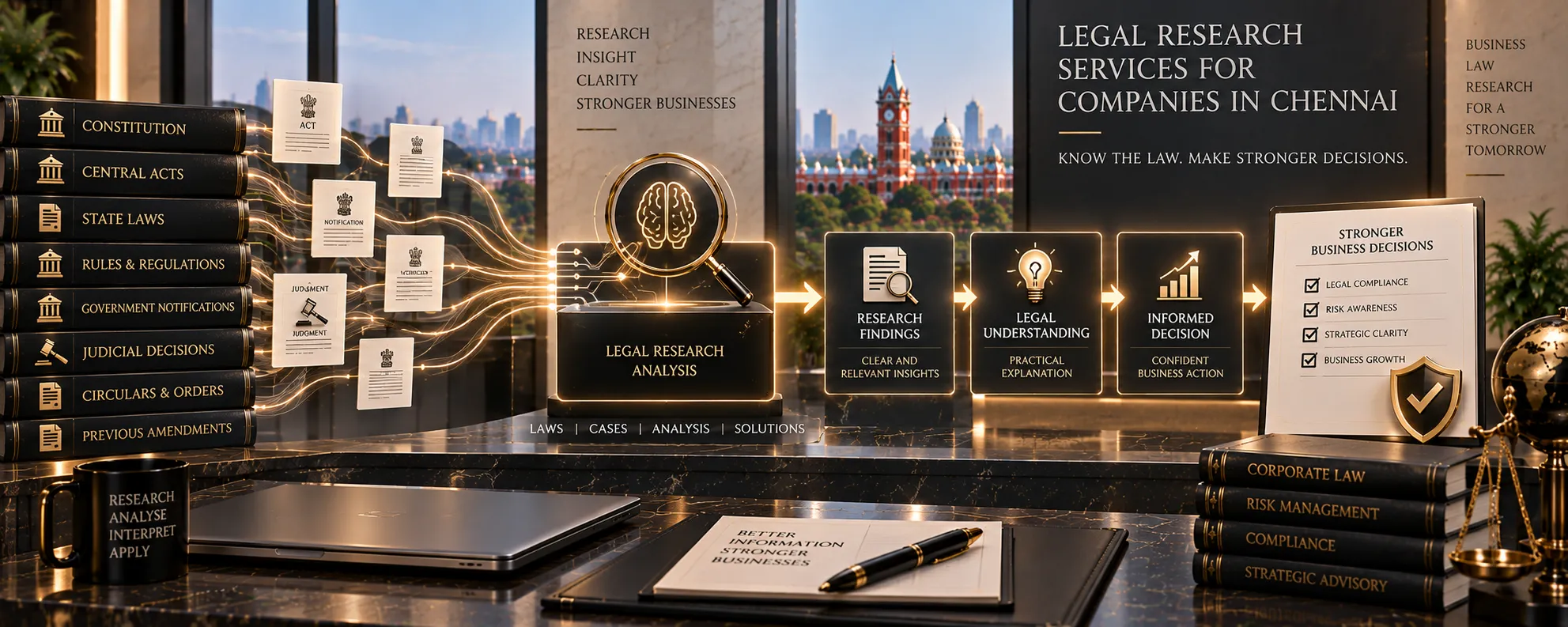
Legal questions rarely exist in isolation. A contract may involve intellectual property. A property transaction may involve corporate authority. An employment dispute may involve statutory compliance. A commercial disagreement may require both contract interpretation and case law research.
This is why legal research needs to be connected to the actual transaction, business objective, or dispute.
Legal Prime provides legal research services in Chennai for companies, businesses, professionals, and clients who require focused legal analysis before making important decisions. Our approach is based on understanding the issue first, researching the applicable law carefully, and presenting the findings in a form that can support the next legal or commercial step.
If you are dealing with a complex legal question, reviewing an important agreement, preparing for a dispute, or evaluating a business transaction, professional legal research can provide a stronger foundation for the decision ahead.
Legal Research Before Important Decisions
Professional legal research can provide a stronger foundation for understanding the legal position before taking the next legal or commercial step.