
Legal Risk Assessment for Contracts and Business Documents
A contract can look complete and still leave a business exposed to unnecessary legal risk. A missing protection, unclear obligation, one sided liability clause, weak termination provision, or poorly defined responsibility can create problems much later.
Legal risk assessment is therefore an important part of the legal drafting process. Before a contract is prepared or signed, it helps identify the areas that could create financial, operational, legal, or commercial exposure.
At Legal Prime, our legal risk assessment services focus on reviewing the proposed transaction, understanding the business relationship, identifying possible areas of exposure, and helping structure the legal document accordingly. The objective is not to make every contract unnecessarily complicated. It is to make sure the important risks are identified and addressed before they become disputes.
Our approach is particularly useful for companies, startups, business owners, professionals, and organisations dealing with commercial agreements, employment documents, vendor contracts, technology agreements, property documents, service agreements, and other business arrangements.
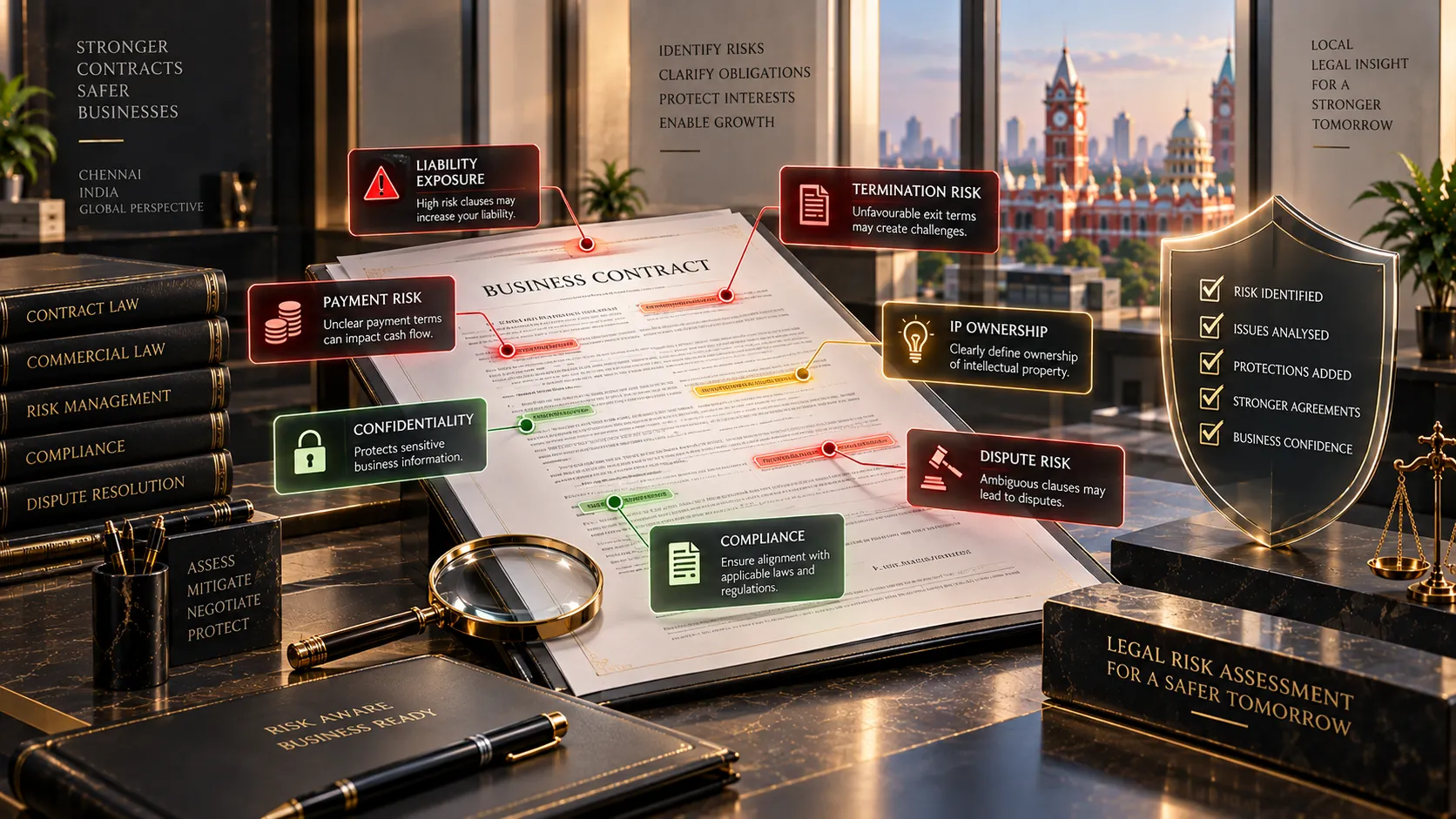
What Is Legal Risk Assessment?
Legal risk assessment is the process of identifying and evaluating the legal risks that may arise from a contract, agreement, transaction, business decision, or legal document.
In the context of legal drafting, the assessment is carried out before or during the preparation of the document. The lawyer considers what each party is expected to do, what could go wrong, who may be responsible if something goes wrong, and whether the agreement provides adequate protection.
Risk Should Be Identified Before It Becomes a Dispute
For example, imagine a company entering into a service agreement with a technology vendor. The business may focus mainly on price and delivery timelines. However, a proper legal risk assessment may raise other questions.
These questions can significantly affect the company’s position. Identifying them before drafting allows the agreement to address the risks in a more structured way.
Why Legal Risk Assessment Is Important Before Drafting a Contract
Many businesses start with a standard agreement and change a few names, dates, prices, and clauses. This may appear convenient, but a template cannot automatically understand the commercial relationship between the parties.
Every transaction has its own risks.
A vendor agreement may require strong service level protections. A software agreement may need detailed intellectual property and data provisions. An employment agreement may need appropriate confidentiality and restrictive provisions. A property transaction may require specific representations, title protections, and conditions.
Legal risk assessment helps identify these differences before the final document is prepared.
A good assessment can help a business:
The purpose is preventive. It is usually easier to address a risk while negotiating a contract than after the relationship has broken down.
Legal Risk Assessment and Legal Drafting Are Closely Connected
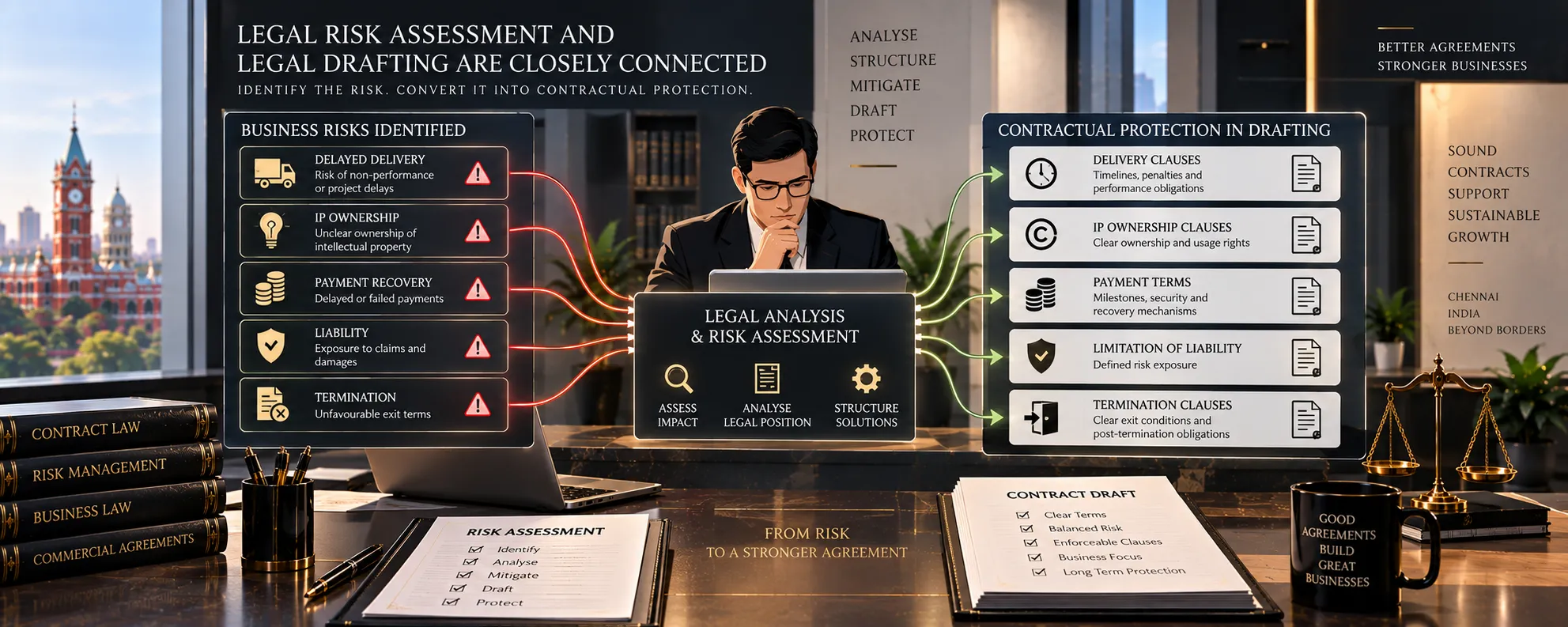
Risk assessment and legal drafting should not be treated as two completely separate activities.
The assessment tells the drafter what needs protection. Drafting then converts that legal analysis into contractual language.
For example, if a business identifies delayed delivery as a major commercial risk, the contract may need clear delivery obligations, timelines, consequences for delay, service credits, termination rights, or other appropriate protections.
If intellectual property ownership is a concern, the agreement may need clear provisions covering ownership, licensing, permitted use, confidentiality, and post termination rights.
If payment recovery is a concern, the contract may need clearly defined payment terms, interest or other agreed consequences, invoicing procedures, suspension rights, and dispute provisions.
The exact clauses depend on the transaction and applicable law. The important point is that drafting should respond to the actual risks of the relationship.
Identify the Risk
Understand what could go wrong, who may be exposed, and which areas require protection.
Build the Protection
Translate the legal analysis into clear contractual obligations, rights, protections, and remedies.
What We Assess During Legal Risk Review
A legal risk assessment can cover different areas depending on the document.
| Risk Area | What We Look For | Why It Matters |
|---|---|---|
| Contract obligations | Duties of each party | Prevents unclear responsibilities |
| Liability | Who bears losses and to what extent | Helps control financial exposure |
| Indemnity | Circumstances requiring compensation | Protects against specific third party or contractual claims |
| Termination | Rights and consequences of ending the agreement | Helps manage failed relationships |
| Payment | Fees, timelines, delays and recovery rights | Reduces payment disputes |
| Intellectual property | Ownership and permitted use | Protects business assets |
| Confidentiality | Information protection | Reduces misuse of sensitive information |
| Dispute resolution | Process for resolving disagreements | Provides a defined route when disputes arise |
| Governing law | Applicable legal framework | Creates clarity about the legal basis |
| Compliance | Relevant statutory requirements | Reduces regulatory exposure |
Not every contract needs the same level of protection. The review should reflect the actual transaction rather than adding standard clauses without purpose.
Types of Contracts That May Need Legal Risk Assessment
Legal risk assessment can be useful across many types of business documents.
Vendor and Supplier Agreements
Vendor contracts can create risks around delivery, quality, payment, warranties, replacement, confidentiality, and termination.
A risk assessment helps determine whether the agreement protects the company if the vendor does not perform as expected.
Client and Service Agreements
Service contracts should clearly define the scope of work, deliverables, timelines, payment obligations, responsibilities, and limitations.
Unclear scope is a common source of commercial disagreements. Risk assessment can identify areas where the agreement needs greater clarity.
Employment Agreements
Employment documentation can involve confidentiality, intellectual property, duties, compensation, termination, notice requirements, and workplace obligations.
The assessment should consider the nature of the role and the applicable legal framework rather than relying entirely on a generic employment template.
Non Disclosure Agreements
An NDA should do more than simply state that information is confidential.
The parties should understand what information is protected, how it can be used, who can receive it, how long confidentiality obligations continue, and what happens when the relationship ends.
Technology and SaaS Agreements
Technology contracts often involve software access, intellectual property, data, cybersecurity, service availability, customer information, payment, support, and termination.
These agreements may require a more detailed risk review because several legal and operational issues can exist at the same time.
Partnership and Business Agreements
Business relationships involving partners, investors, distributors, or strategic collaborators can create risks around decision making, ownership, responsibilities, exit rights, confidentiality, and dispute resolution.
A legal risk assessment can help identify these issues before the relationship becomes difficult to manage.
Property Related Agreements
Lease agreements, development agreements, sale arrangements, joint development agreements, and other property documents may involve significant financial commitments.
Risk assessment can help identify issues relating to ownership, obligations, approvals, possession, payment, termination, and other transaction specific concerns.
How Our Legal Risk Assessment Process Works
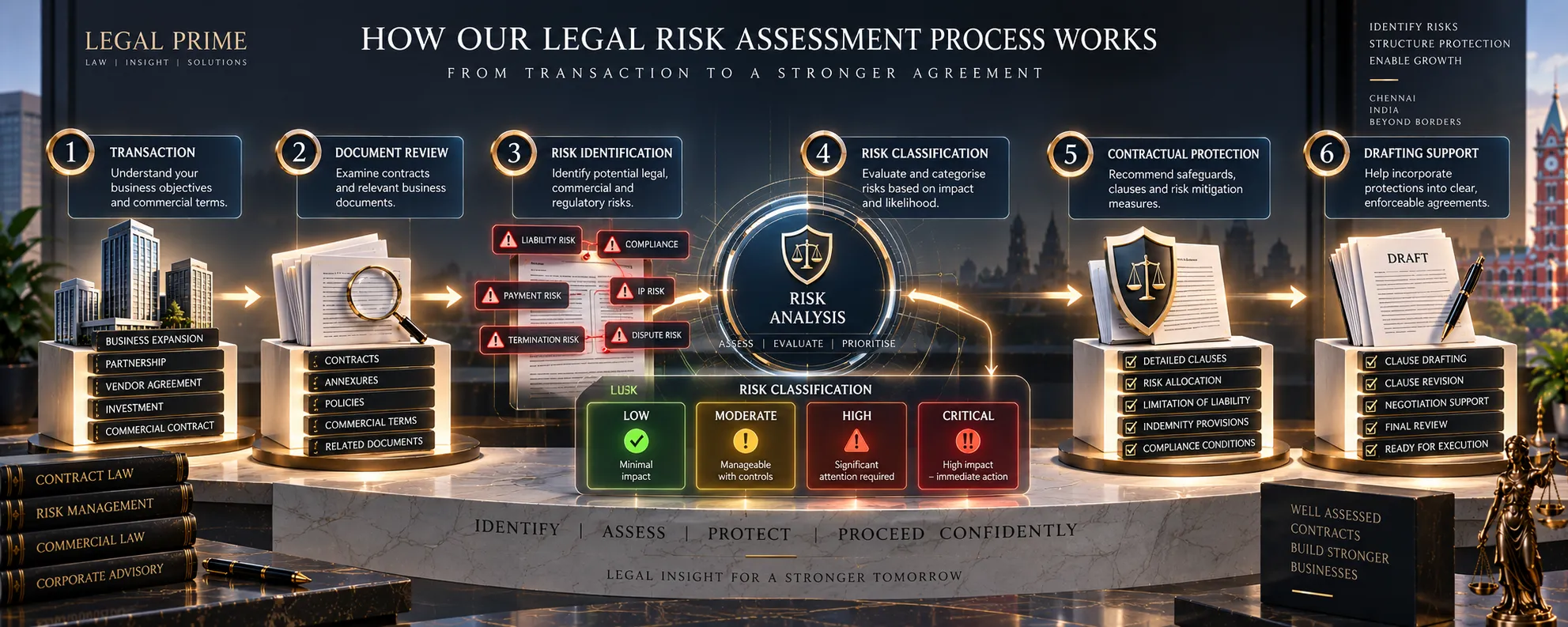
Understanding the Transaction
We first understand what the parties are trying to achieve.
The same type of agreement can carry different risks depending on the commercial arrangement. A service agreement for a small project may require different protections from a long term agreement involving sensitive technology or customer data.
Reviewing the Available Documents
Relevant contracts, proposals, correspondence, business terms, previous agreements, and other documents are reviewed where required.
This helps connect the legal review with the actual commercial arrangement.
Identifying Legal and Commercial Risks
The next stage is to identify areas where the client could face exposure.
This may include contractual, financial, regulatory, intellectual property, confidentiality, employment, operational, or dispute related risks.
Assessing the Level of Risk
Not every issue has the same importance.
A practical assessment can classify issues based on their likely impact and relevance to the transaction.
Recommending Contractual Protection
Once the risks are identified, appropriate contractual protections can be considered.
Depending on the matter, this may involve revising obligations, adding definitions, clarifying responsibilities, introducing appropriate representations and warranties, improving termination provisions, or restructuring other parts of the agreement.
Supporting the Drafting Process
The final stage is to translate the legal assessment into a clear contractual structure.
The objective is to create a document that reflects the actual commercial understanding while addressing important legal risks.
This classification is not a fixed legal formula. It is a practical way of helping the client understand which issues deserve immediate attention.
What Is a Contract Risk Matrix?
A contract risk matrix is a structured method of recording important risks identified during a legal review.
It allows business owners and decision makers to see the issue, understand its possible impact, and determine what action should be taken.
| Issue | Potential Risk | Impact | Recommended Action |
|---|---|---|---|
| Unclear scope | Disagreement over deliverables | High | Define scope and responsibilities |
| Unlimited liability | Unexpected financial exposure | High | Review liability structure |
| Weak termination clause | Difficulty exiting contract | High | Clarify termination rights |
| No IP ownership clause | Ownership dispute | High | Define ownership and permitted use |
| Unclear payment terms | Delayed or disputed payments | Moderate | Specify payment obligations |
| Broad confidentiality clause | Unclear obligations | Moderate | Define protected information |
| No dispute mechanism | Difficult dispute handling | Moderate | Establish suitable mechanism |
A risk matrix is especially useful for companies reviewing multiple agreements because it provides a consistent way to communicate legal issues internally.
Common Contract Risks Businesses Miss
Using a Generic Template
Templates can provide a starting point, but they may not reflect the actual transaction.
A document prepared for one type of business relationship may not provide suitable protection for another.
Focusing Only on Price
Commercial negotiations often focus heavily on pricing.
However, liability, termination, intellectual property, warranties, confidentiality, and dispute provisions can have a much greater impact if the relationship fails.
Ignoring Exit Rights
Businesses often spend considerable time discussing how a relationship will begin and much less time considering how it can end.
A well drafted agreement should address appropriate termination scenarios and the consequences of termination.
Not Defining Responsibilities
When responsibilities are unclear, each party may have a different understanding of what was agreed.
Clear obligations reduce the scope for later disagreement.
Accepting Unlimited Liability Without Review
A broad liability clause can expose a company to significant financial consequences.
The commercial context and applicable law should be considered before accepting such provisions.
Ignoring Intellectual Property
This is particularly important for software companies, agencies, consultants, designers, manufacturers, and businesses creating content or technology.
The agreement should make the intended ownership or usage rights clear.
Treating Confidentiality as a Standard Clause
Confidentiality obligations should reflect the information actually being exchanged and the nature of the relationship.
Signing Before Legal Review
Once a contract is signed, changing the terms may become significantly more difficult.
Legal review before execution gives the business an opportunity to address concerns while there is still room for negotiation.
What Is the Difference Between Legal Risk Assessment and Contract Review?
They are related but not identical.
In many transactions, both processes work together.
The risk assessment identifies what matters. The contract review checks whether the document actually deals with those matters.
What Is the Difference Between Legal Risk and Commercial Risk?
Legal Risk
Legal risk concerns the possibility of legal consequences arising from a transaction, document, or action.
Commercial Risk
Commercial risk concerns the potential impact on the business, such as financial loss, operational disruption, delayed delivery, loss of customers, or damage to a business relationship.
The two can overlap.
For example, an unclear payment clause may create a commercial risk because the company may face delayed payments. It can also create a legal risk if the parties later disagree about their contractual obligations.
For business contracts, considering both sides gives a more useful picture than looking only at legal wording.
Who Needs Legal Risk Assessment Services?
Legal risk assessment can be useful for:
The level of review should depend on the value, complexity, duration, and legal significance of the transaction.
When Should a Company Get a Legal Risk Assessment?
A business should consider legal risk assessment when a contract involves significant financial commitments, long term obligations, intellectual property, confidential information, regulatory requirements, important customers, strategic partnerships, or substantial liability.
It can also be useful when a company is entering an unfamiliar type of transaction.
The earlier the risks are identified, the more options the business generally has to address them during negotiation and drafting.
How Legal Risk Assessment Helps During Negotiation
A legal review should not simply produce a list of problems.
The practical value comes from helping the business understand which issues are important and how they may be addressed.
Identify Exposure
For example, if the other party proposes unlimited liability, the business needs to understand the potential exposure.
Consider Protection
The business can consider whether an appropriate limitation or allocation of risk can be negotiated.
Negotiate Balance
If a client wants broad termination rights, the other party may need to understand the commercial consequences and negotiate a balanced arrangement.
This makes legal risk assessment useful before and during contract negotiations.
A Practical Example
Chennai Based Company and Technology Provider
Consider a Chennai based company entering into a three year service agreement with an external technology provider.
The proposed agreement contains a fixed annual fee, a general service obligation, and a short termination clause.
At first glance, the contract may appear straightforward.
During legal risk assessment, several questions arise.
These questions can then guide the drafting and negotiation process.
The example demonstrates why contract risk assessment should consider the business relationship as a whole rather than reading clauses individually.
Why Legal Prime for Legal Risk Assessment?
Legal risk assessment requires an understanding of both legal principles and the commercial purpose behind the document.
At Legal Prime, our approach focuses on understanding the transaction first and then identifying the legal issues that may affect it.
Our legal drafting and risk assessment work can support businesses with:
We focus on clear explanations so that business owners can understand what a legal issue means for their actual transaction.
Frequently Asked Questions
What is legal risk assessment in contract drafting?
Legal risk assessment in contract drafting is the process of identifying possible legal and commercial risks before those risks are addressed through contractual terms.
Why is risk assessment important before signing a contract?
It helps identify important obligations, liabilities, missing protections, and potential dispute areas before the agreement becomes binding.
Can a lawyer assess risks before drafting a contract?
Yes. Reviewing the transaction before drafting can help determine which protections and provisions should be considered in the agreement.
What are the most common legal risks in business contracts?
Common risks include unclear obligations, broad liability, weak termination rights, payment disputes, intellectual property issues, confidentiality concerns, and unclear dispute mechanisms.
Is contract review the same as legal risk assessment?
No. Contract review examines the document, while legal risk assessment focuses more broadly on identifying the legal and commercial risks connected with the transaction.
Can legal risk assessment help startups?
Yes. Startups often enter vendor, employment, investor, technology, and customer agreements where early legal review can help avoid problems later.
What is a contract risk matrix?
A contract risk matrix is a structured table used to identify important contractual risks, assess their potential impact, and record recommended actions.
Can risk assessment be done for employment contracts?
Yes. Employment documents can be reviewed for issues relating to duties, confidentiality, intellectual property, termination, and other applicable obligations.
Can companies get legal risk assessment for vendor agreements?
Yes. Vendor agreements can be assessed for payment, delivery, performance, liability, confidentiality, termination, and other relevant risks.
Can legal risk assessment prevent disputes?
It cannot guarantee that a dispute will never occur. However, identifying unclear terms and foreseeable risks before signing can help reduce avoidable areas of disagreement.
When should legal risk assessment be done?
Ideally, it should be considered before a significant contract is finalised or signed, particularly where the agreement involves substantial financial, operational, or legal exposure.
Does every contract need the same level of risk assessment?
No. The depth of review should depend on the nature, value, complexity, duration, and risk profile of the transaction.
Legal Risk Assessment for Companies in Chennai
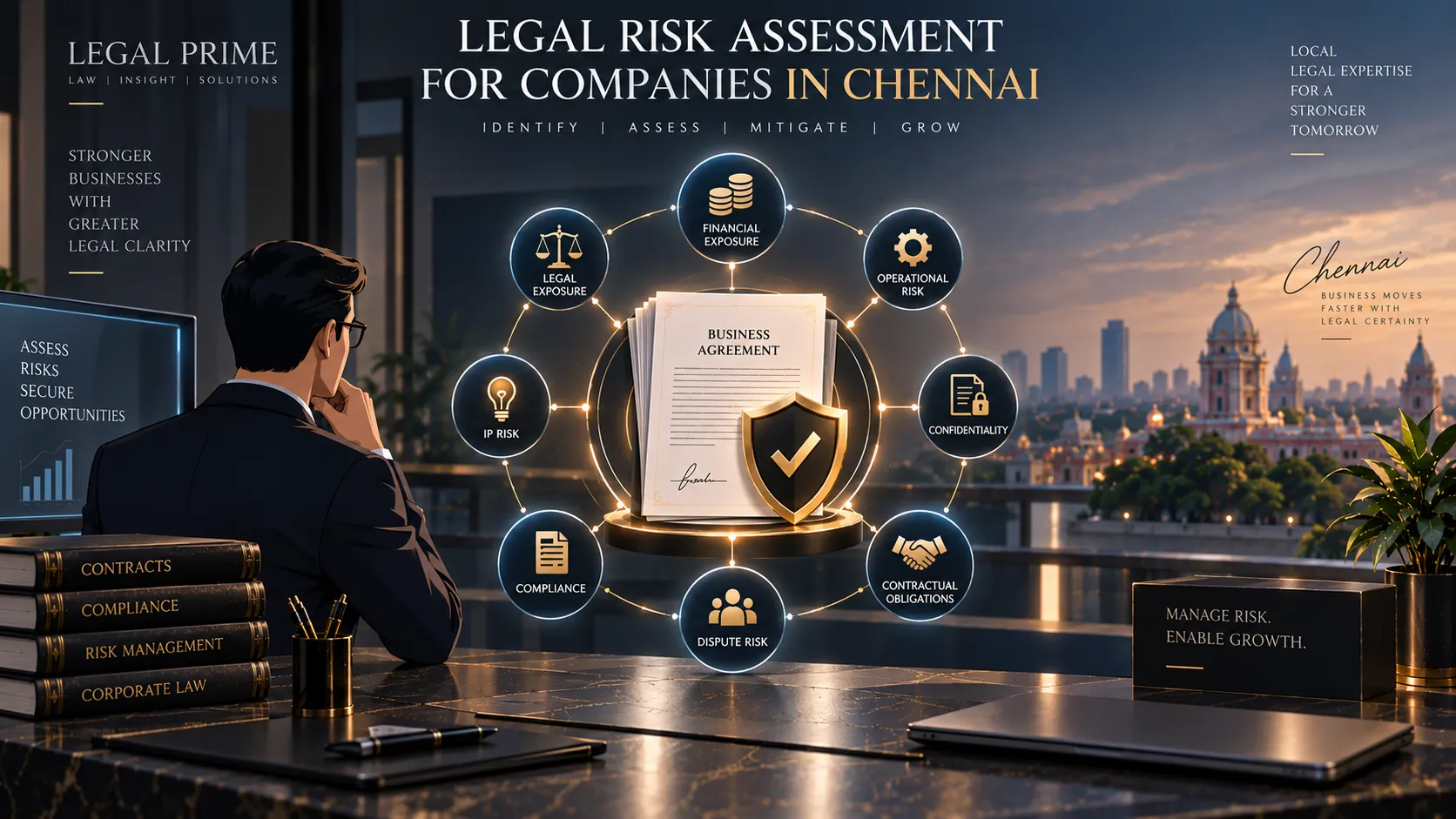
A contract is more than a document that records an agreement. It defines responsibilities, allocates risk, protects commercial interests, and provides a framework for dealing with problems when they arise.
That is why legal risk assessment should form part of the drafting process for important business agreements.
Legal Prime provides legal risk assessment and drafting support for companies and businesses in Chennai, helping clients identify important contractual risks before they become difficult and expensive problems.
The right approach is not to add unnecessary legal language to every document. It is to understand the transaction, identify the risks that genuinely matter, and draft the agreement around those risks.
For businesses entering an important agreement, a focused legal risk assessment can provide clarity before the document is signed and help create a stronger foundation for the commercial relationship.
Identify Legal Risk Before It Becomes a Business Problem
A focused legal risk assessment can provide clarity before an important business agreement is finalised or signed.